Quick Answer
For a full-depth residential driveway, 4 inches of compacted asphalt is a common minimum, while heavier use or weak foundation conditions may require 5–6 inches. The right thickness also depends on traffic, subgrade, drainage, and the pavement structure.
Choosing the right thickness is important for preventing premature cracking, rutting, and costly repairs. This Asphalt Thickness Guide explains how asphalt thickness varies for driveways, parking lots, roads, and heavy-duty applications.
You’ll also learn how traffic, soil, drainage, climate, and the pavement base affect the thickness a project actually needs.
In This Guide, You’ll Learn
Why Asphalt Thickness Matters
Many homeowners focus on the asphalt mix or the contractor’s price, but thickness has a direct impact on pavement performance. Even a well-installed surface can fail early if it isn’t designed for the expected traffic.
The correct asphalt thickness helps:
- Support vehicle loads without excessive flexing.
- Reduce cracking caused by repeated traffic.
- Resist rutting in hot weather.
- Extend the pavement’s service life.
- Lower long-term repair and maintenance costs.
For example, a driveway used only by passenger cars doesn’t need the same pavement structure as one that regularly supports delivery trucks or a large RV. Designing for the actual traffic—not the occasional vehicle—usually produces the best long-term value.
Asphalt Thickness vs. Total Pavement Thickness
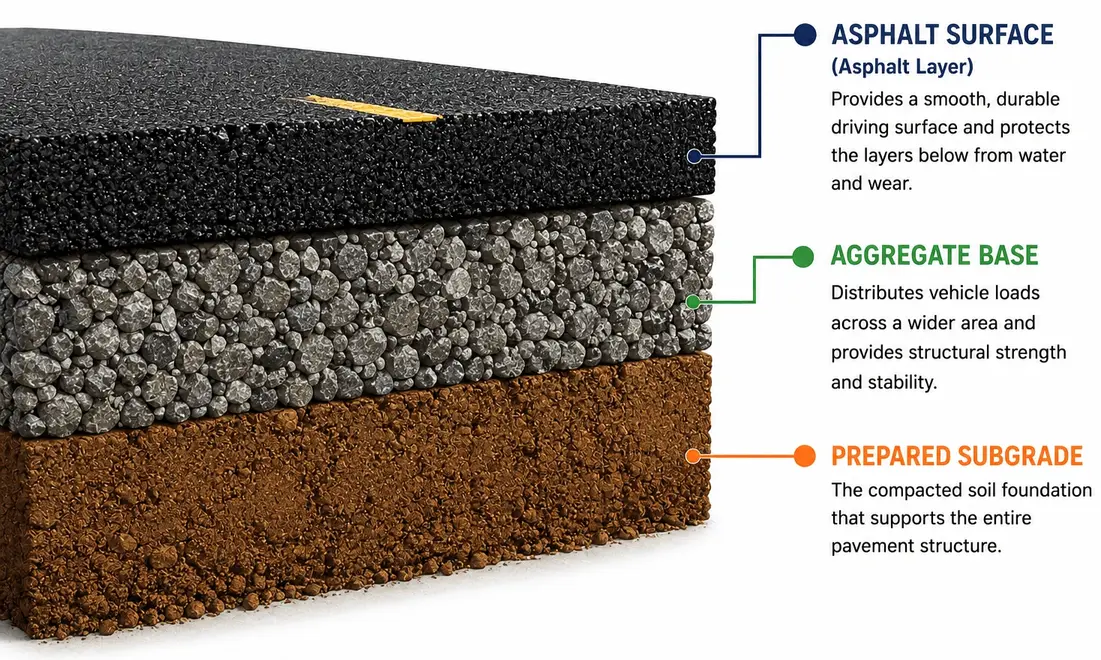
One of the most common misunderstandings is assuming that the asphalt layer and the entire pavement structure are the same thing. They are not.
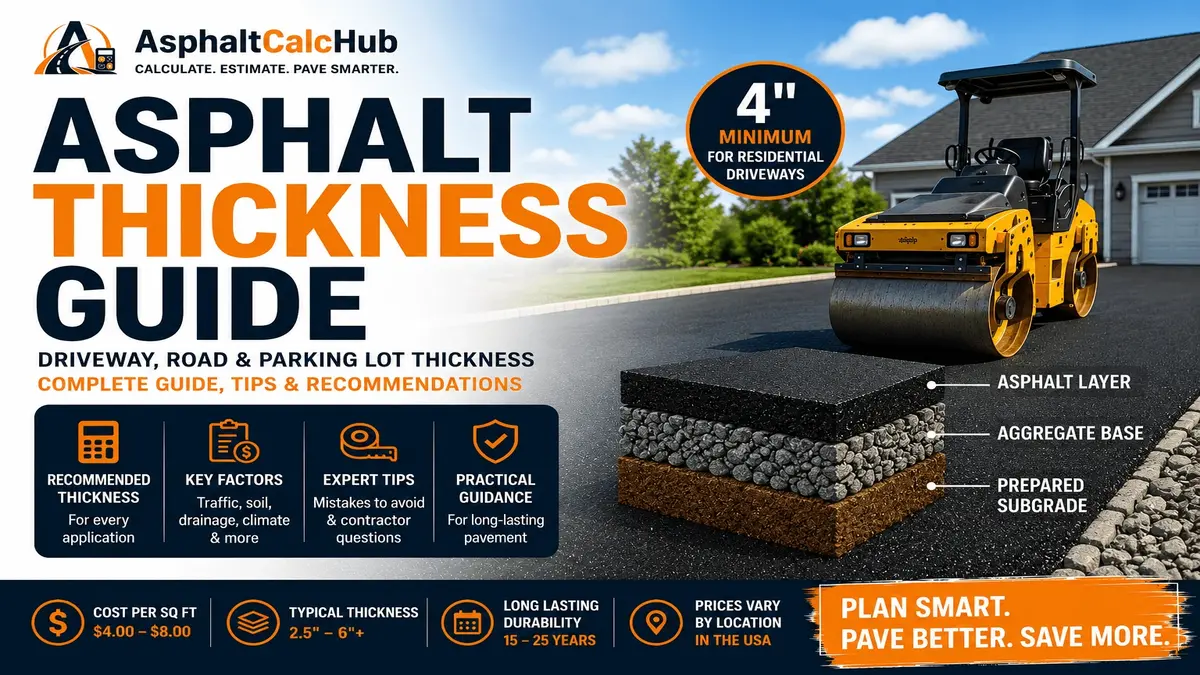
A typical asphalt pavement consists of three main parts:
| Layer | Purpose |
| Asphalt Surface | Provides a smooth, durable driving surface and protects lower layers from water. |
| Aggregate Base | Distributes vehicle loads and provides structural support. |
| Prepared Subgrade | The compacted soil foundation that supports the entire pavement system. |
Think of asphalt like the roof of a house. A high-quality roof still depends on a strong structure underneath. In the same way, even thicker asphalt cannot fully compensate for a weak or poorly compacted base.
A strong pavement depends on more than the asphalt layer. The aggregate base and subgrade help distribute loads and provide a stable foundation, while proper drainage helps protect those layers from moisture-related damage.
Once you know the required thickness and project area, you can estimate the amount of asphalt needed and check how much a yard of asphalt costs.
Recommended Asphalt Thickness by Application
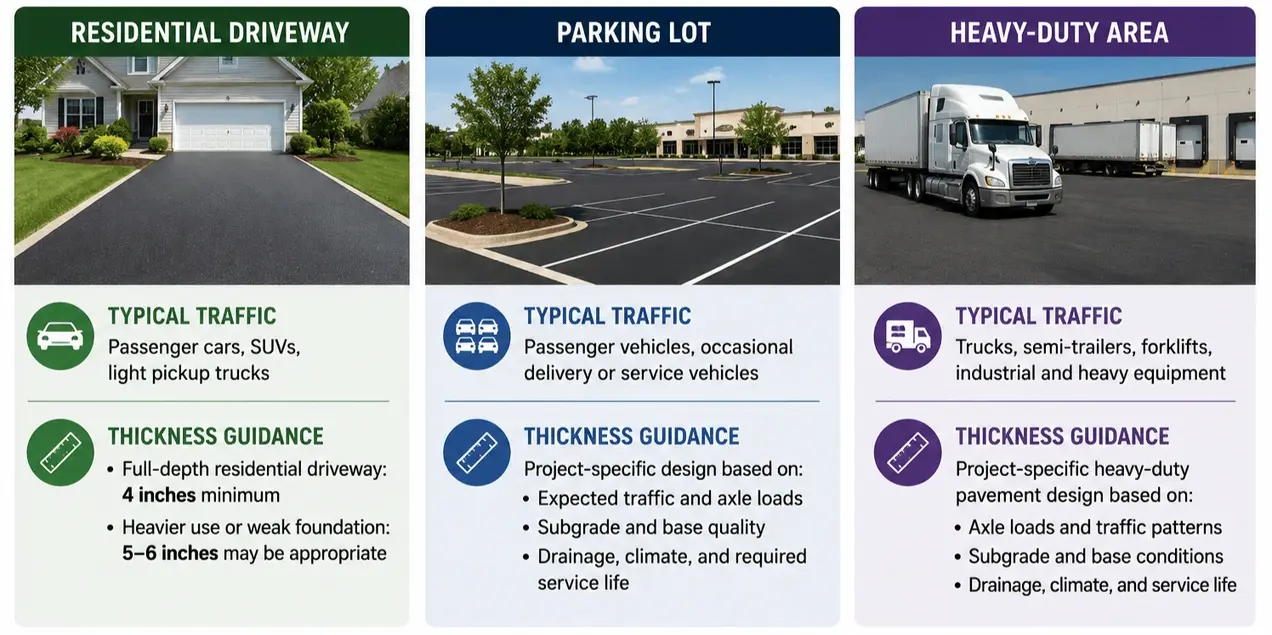
The right asphalt thickness depends on traffic load, subgrade strength, drainage, and the overall pavement structure. These are practical reference points, but commercial and public projects should use a project-specific pavement design.
| Application | Practical Thickness Guidance |
| Full-depth residential driveway | 4 inches minimum |
| Residential driveway with heavier use | 5–6 inches may be appropriate |
| Parking lots | Project-specific design based on traffic and foundation conditions |
| Heavy truck areas | Project-specific heavy-duty pavement design |
| Local roads | Project-specific pavement design |
| Highways | Engineered pavement design |
For residential driveways, the Asphalt Institute recommends a minimum of 4 inches of compacted full-depth asphalt on a properly prepared subgrade. If foundation conditions are poor or an exceptional number of heavy vehicles are expected, 5 inches or, under extreme conditions, 6 inches may be appropriate.
Commercial parking lots, truck areas, and roads should not be assigned one universal thickness. Pavement design considers traffic, axle loads, subgrade, base materials, climate, drainage, and the required service life.
1. Asphalt Thickness for a Residential Driveway
For a full-depth residential driveway, 4 inches of compacted asphalt is a practical minimum reference when the subgrade has been properly prepared.
This is suitable for many driveways carrying normal automobiles and occasional trucks. If the foundation is weak or the driveway will regularly support unusually heavy vehicles, a thicker pavement structure may be appropriate.
Pro Tip: Ask whether the quoted thickness is the finished thickness after compaction.
2. Asphalt Thickness for Heavy Vehicles
RVs, work trucks, delivery vehicles, and other heavy vehicles place greater demands on pavement than normal passenger cars.
For a residential driveway with exceptional heavy-vehicle use, the Asphalt Institute indicates that increasing full-depth asphalt to 5 inches or, under extreme conditions, 6 inches may be appropriate. Commercial truck areas require a project-specific pavement design based on actual traffic and axle loading.
Key Takeaway: Heavy traffic may require a stronger entire pavement structure, not simply a thicker surface.
3. Asphalt Thickness for Parking Lots
Parking lots vary widely in traffic. A small lot used mainly by passenger vehicles has different requirements from a commercial lot that receives frequent delivery trucks.
Rather than using one universal thickness, the pavement should be designed around expected traffic, subgrade support, base materials, drainage, and climate. FHWA describes pavement thickness as a project-level design decision based on site-specific conditions and predicted traffic.
4. Asphalt Thickness for Trucks
There is no single asphalt thickness that is appropriate for every truck application. Truck loading areas, warehouse entrances, bus lanes, and industrial yards experience substantially different axle loading and traffic patterns.
For these projects, thickness should be determined through a heavy-duty pavement design rather than applying a residential driveway rule.
5. Asphalt Thickness for Roads
Road pavement thickness varies according to traffic, truck loading, subgrade conditions, climate, drainage, and the required service life.
State highway agencies use pavement-design procedures appropriate for their local conditions, so there is no single thickness that applies to every U.S. road.
Asphalt Layer Thickness: Surface, Binder, and Base
When someone says an asphalt pavement is “4 inches thick,” it is important to understand what that measurement includes.
An asphalt pavement may contain multiple asphalt courses, such as a surface course and a binder or intermediate course, placed over an aggregate base.
The surface course provides the finished riding surface and helps protect the pavement from weather and traffic. The lower asphalt layer provides additional structural capacity.
The aggregate base is separate from the asphalt thickness.
For example, a pavement might have several inches of compacted asphalt over a substantially thicker aggregate base. The total pavement structure is therefore deeper than the asphalt layer alone.
Asphalt Top Coat Thickness
An asphalt top coat, or surface course, is not the same thing as the total asphalt pavement thickness.
When an existing pavement receives an overlay, the required overlay thickness depends on the condition and strength of the existing pavement. Simply adding a thin layer over a structurally failed surface does not solve the underlying problem.
Note: A new asphalt surface can improve appearance, but it cannot reliably fix major structural failure underneath.
What Determines the Right Asphalt Thickness?
Thickness should be selected based on the conditions beneath and above the pavement—not by thickness alone.
1. Vehicle Weight and Traffic
A driveway carrying two family cars has a very different loading pattern from a commercial pavement used by delivery trucks every day.
The more heavy-vehicle traffic a pavement receives, the greater its structural requirements become.
2. Soil and Subgrade Condition
The soil underneath the base is critical.
Strong, well-compacted subgrade provides better support. Weak, wet, expansive, or poorly compacted soil may require additional preparation before asphalt is installed.
This is one reason two properties with similar driveways may not need exactly the same pavement structure.
3. Drainage
Water is one of the biggest enemies of pavement performance.
Poor drainage can weaken the base and subgrade, allowing the pavement to deform or crack even when the asphalt thickness appears adequate.
Proper grading, drainage, and surface water management should therefore be considered before deciding that “more asphalt” is the solution.
4. Climate
Climate also affects pavement performance.
In colder regions, repeated freezing and thawing can damage pavement when water enters cracks or weakens the underlying layers. In hotter regions, asphalt can soften and become more vulnerable to rutting under heavy loads.
The pavement design should account for the local environment rather than applying one thickness recommendation everywhere.
5. Base Thickness and Quality
The aggregate base distributes loads from vehicles into the subgrade.
A properly graded, placed, and compacted base provides a stable foundation for the asphalt. If the base is weak, simply increasing asphalt thickness may not provide the expected improvement.
In practical terms: good asphalt + poor base = poor pavement performance.
2 vs. 3 vs. 4 Inches of Asphalt: Which Is Right?
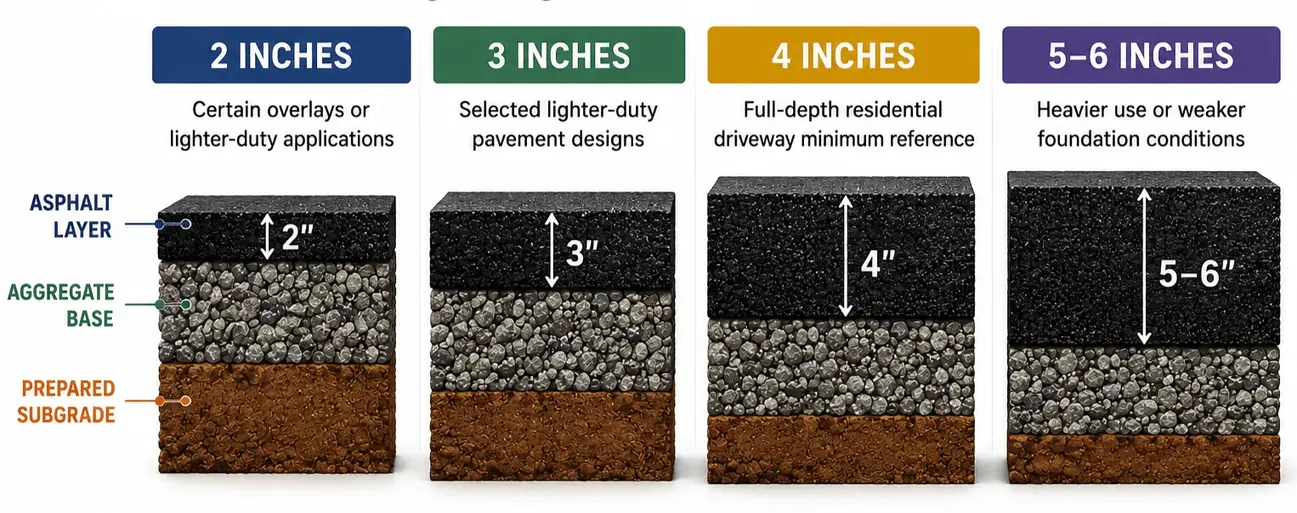
The difference between 2, 3, and 4 inches matters, but the correct choice depends on how the asphalt will be used and what supports it underneath.
| Thickness | Typical Use |
| 2 inches | Certain overlays or lighter-duty applications |
| 3 inches | Selected lighter-duty pavement designs |
| 4 inches | Full-depth residential driveway minimum reference |
| 5–6 inches | Heavier residential use or weaker foundation conditions |
These figures refer to compacted asphalt thickness.
Is 2 Inches of Asphalt Enough?
Two inches can be appropriate for some resurfacing or specifically designed applications, but it should not automatically be treated as adequate for a new full-depth residential driveway.
For a full-depth residential driveway, the Asphalt Institute recommends at least 4 inches of compacted asphalt on a properly prepared subgrade.
Is 3 Inches of Asphalt Enough?
Three inches may be suitable for certain lighter-duty or specifically designed pavement applications, but it should not be presented as the standard full-depth residential driveway thickness.
For a new full-depth residential driveway, 4 inches is the better minimum reference based on Asphalt Institute guidance.
When Should You Use 4 Inches or More?
Four inches is the minimum full-depth residential driveway reference from the Asphalt Institute. Five inches or, under extreme conditions, six inches may be appropriate when foundation conditions are a concern or unusually heavy vehicle use is expected.
For commercial and heavy-truck pavement, the required thickness should be established through project-specific pavement design rather than a simple 4-inch rule.
Real-World Asphalt Thickness Examples
A two-car family driveway and a warehouse entrance may have similar pavement areas, but they do not experience the same loading.
1. Family Driveway
A driveway used mainly by passenger cars can follow residential pavement guidance, with 4 inches of compacted full-depth asphalt as a practical minimum reference when the foundation is properly prepared.
A smaller residential driveway can have very different material and installation requirements depending on its size, thickness, and site conditions. See our 10×10 asphalt driveway cost guide for a smaller real-world example.
2. RV or Heavy-Use Driveway
If a residential driveway regularly supports an RV or an unusually high number of heavy vehicles, the pavement may need additional thickness and stronger foundation preparation. The Asphalt Institute notes that 5–6 inches may be appropriate under more demanding residential conditions.
For a medium-sized residential example, our 20×20 asphalt driveway cost guide shows how driveway size affects material requirements and project pricing.
3. Commercial or Truck Facility
A commercial parking area or truck facility should be designed around its actual traffic and axle loads. A generic residential thickness should not be used for these applications.
A larger residential driveway may require more material and may have different cost considerations. For a detailed 800-square-foot example, see our 20×40 asphalt driveway cost guide.
Common Asphalt Thickness Mistakes
1. Choosing Thickness Based Only on Price
The cheapest paving quote is not necessarily the cheapest pavement over its lifetime.
A lower initial price may reflect less asphalt, inadequate base preparation, or both.
2. Ignoring the Aggregate Base
Homeowners sometimes ask, “How many inches of asphalt am I getting?” but never ask about the base.
That is incomplete.
The contractor should be able to explain the planned asphalt thickness, aggregate base, compaction, and subgrade preparation.
3. Confusing Loose and Compacted Asphalt
Asphalt is placed and then compacted. The thickness before compaction is not necessarily the final thickness after compaction.
Always compare contractor quotes using the finished compacted thickness.
4. Designing for the Wrong Vehicle
A driveway designed for passenger cars may not perform well when it becomes a regular parking area for heavy trucks.
Think about the vehicles that will use the pavement throughout its service life, not just the vehicle you own today.
5. Using Extra Asphalt to Fix a Weak Foundation
Adding asphalt does not automatically solve a weak or unstable foundation. If poor soil, excess moisture, inadequate compaction, or drainage is causing the problem, the underlying pavement structure may need to be corrected first.
Questions to Ask an Asphalt Contractor
Before accepting a paving quote, ask these simple questions:
- What is the finished compacted asphalt thickness?
- How thick will the aggregate base be?
- How will the existing soil be prepared and compacted?
- What asphalt mix will be used?
- How will drainage be handled?
- Is the thickness designed for my expected vehicle traffic?
- Will the quoted thickness be measured after compaction?
A professional contractor should be able to explain the pavement structure clearly instead of giving you only a single thickness number.
Pro Tip: Get the asphalt thickness and base thickness written into the contract.
How to Get the Right Asphalt Thickness for Your Project
Start with the actual conditions of the project rather than choosing a thickness from a generic chart.
For a full-depth residential driveway, 4 inches of compacted asphalt is a practical minimum reference when the subgrade is properly prepared. Heavier use or poor foundation conditions may require more.
For parking lots, roads, and heavy-truck areas, consider traffic, axle loads, subgrade, base materials, drainage, climate, and the required service life. These projects are better handled with a project-specific pavement design.
The goal is not to install the thickest asphalt possible. It is to build a pavement structure that matches the conditions and expected traffic.
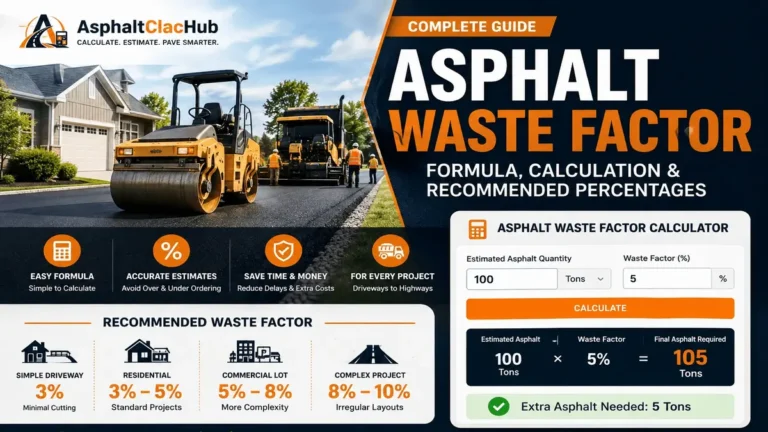
Once you know the required pavement thickness, you can estimate the material quantity and account for normal material loss with an asphalt waste factor.
Expert Takeaway for Asphalt Thickness
The right asphalt thickness is the one that matches the traffic, foundation, drainage, and site conditions. For residential driveways, verify the finished compacted thickness and subgrade preparation before accepting a paving quote.
For commercial roads and heavy-truck areas, rely on a project-specific pavement design rather than a one-size-fits-all thickness.
FAQ forAsphalt Thickness
How thick should an asphalt driveway be?
A full-depth residential driveway generally needs at least 4 inches of compacted asphalt on a properly prepared subgrade.
How thick should asphalt be for trucks?
Heavy-truck pavement should be designed around axle loads, traffic, subgrade, drainage, and the supporting pavement structure.
Is 2 inches of asphalt enough?
It can work for certain overlays or lighter-duty applications, but it should not automatically be considered adequate for a new full-depth residential driveway.
Does thicker asphalt always last longer?
No. Pavement performance also depends on the base, subgrade, drainage, traffic, materials, and construction quality.
What is the average thickness of an asphalt driveway?
There is no single national average, but 4 inches of compacted asphalt is a useful minimum reference for a full-depth residential driveway.
How thick should asphalt be on a road?
There is no universal thickness; road pavement is designed around traffic, truck loading, subgrade, climate, drainage, and local design requirements.
What is asphalt top coat thickness?
It depends on the pavement design and whether the work is new construction or an overlay.
Should I choose a thicker asphalt driveway?
Only when the expected traffic or site conditions justify it; thicker asphalt cannot replace proper foundation preparation.
Conclusion
The right asphalt thickness depends on more than the surface layer. Traffic, subgrade, base preparation, drainage, and climate all affect pavement performance.
For a lasting result, choose a pavement structure designed for the conditions—not simply the lowest price or the maximum thickness.
Use our free Asphalt Calculator to estimate your asphalt quantity quickly and get a practical starting point for your project.
Sources
This guide was reviewed against established pavement-engineering guidance from:
- Asphalt Institute — Full-Depth Asphalt Pavements for Private Driveways
- Federal Highway Administration (FHWA) — Pavement design, subgrade, drainage, traffic, and structural considerations
- National Asphalt Pavement Association (NAPA) — Asphalt pavement design and construction guidance