Quick Answer
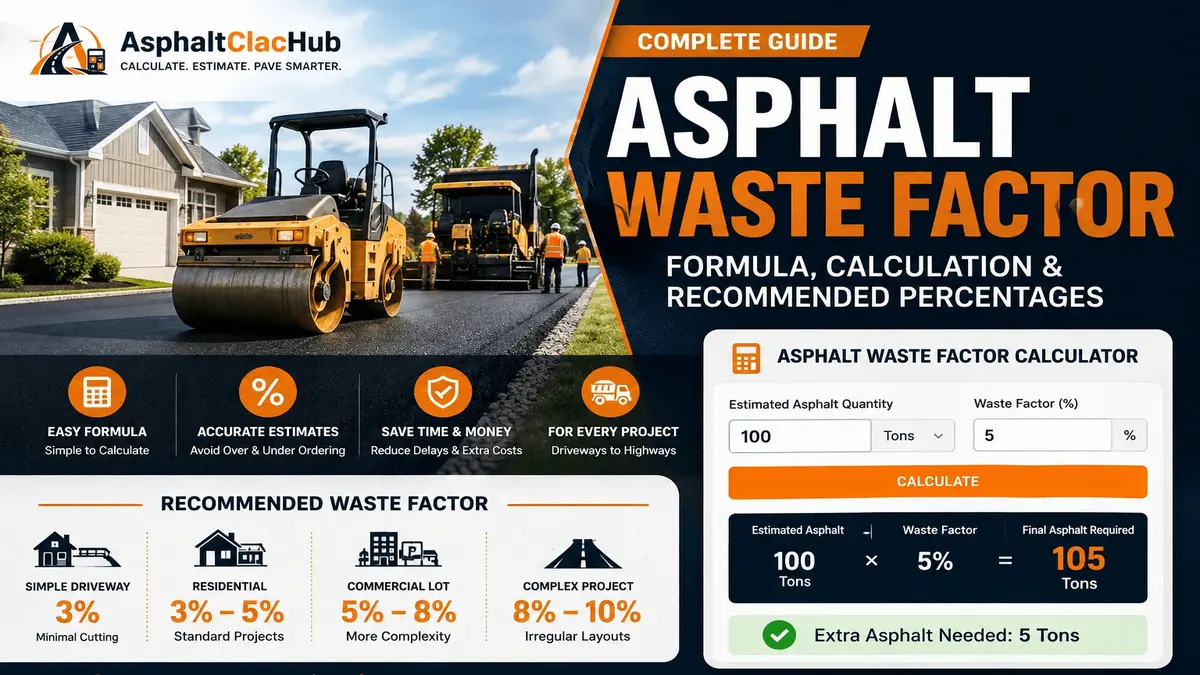
An asphalt waste factor is the extra percentage of asphalt added to an estimate to cover normal material loss during paving. Most residential projects require a 3%–5% waste factor, while complex commercial jobs may need 5%–10%. To calculate the final quantity, multiply your estimated asphalt by 1 + the waste factor.
An asphalt waste factor helps you estimate the right amount of asphalt by accounting for normal material loss during paving.
Whether you’re paving a driveway, parking lot, or private road, using the correct waste factor can help prevent costly shortages and unnecessary overspending.
Before calculating waste, you should first estimate how much asphalt your project needs. See our guide on How Much Is a Yard of Asphalt.
In this guide, you’ll learn what an asphalt waste factor is, how to calculate it, and the recommended percentages for different types of paving projects.
In This Guide, You’ll Learn
What Is an Asphalt Waste Factor?
An asphalt waste factor is the extra percentage of asphalt added to a material estimate to cover the small amount of asphalt that is typically lost during transportation, placement, trimming, and equipment cleanup.
Even experienced paving crews can’t use every pound of asphalt delivered to a job site. Some material sticks inside trucks, some is trimmed from edges, and minor measurement differences can increase the amount required.
Don’t confuse a waste factor with ordering “extra just in case.” It’s a standard estimating practice used to reduce the risk of running short before a project is finished.
Why Every Asphalt Project Needs a Waste Factor
No paving project is completely waste-free. Even a simple driveway can lose small amounts of asphalt during handling, trimming, and placement.
Imagine ordering exactly 20 tons of asphalt for a parking lot. If the crew runs short by just 1 ton, the cost of an additional delivery, crew downtime, and project delays can easily exceed the cost of the missing material.
Using the right waste factor helps you:
- Order enough asphalt the first time
- Reduce the risk of costly delays
- Improve estimate accuracy
- Avoid unnecessary material costs
For most residential projects, a 3%–5% waste factor provides a practical balance between cost and accuracy.
If you’re estimating a driveway, you can also see our cost examples for a 10×10 asphalt driveway, 20×20 asphalt driveway, or 20×40 asphalt driveway.
Quick Tip: A small amount of extra asphalt is usually less expensive than stopping a paving crew because the original order wasn’t enough.
Why Does Asphalt Waste Happen?
Even with careful planning, some asphalt is almost always lost during a paving project. The amount of waste depends on the project’s layout, site conditions, and construction process.
The most common causes include:
1. Edge Cutting and Trimming
Straight driveways create very little waste, but curved edges, parking lot islands, and decorative borders require more cutting. The more trimming involved, the higher the waste factor should be.
2. Material Left in Equipment
A small amount of asphalt often remains inside dump trucks, paver hoppers, wheelbarrows, and other equipment. These small losses add up over the course of a project.
3. Uneven Surface Conditions
Low spots, poor grading, and soft areas may require additional asphalt to achieve a consistent finished thickness.
4. Minor Measurement Errors
Small differences in length, width, or thickness calculations can slightly increase the amount of asphalt needed. A waste factor provides a practical safety margin for these variations.
Professional Tip: Most waste comes from project complexity—not poor-quality asphalt.
Recommended Asphalt Waste Factor by Project Type
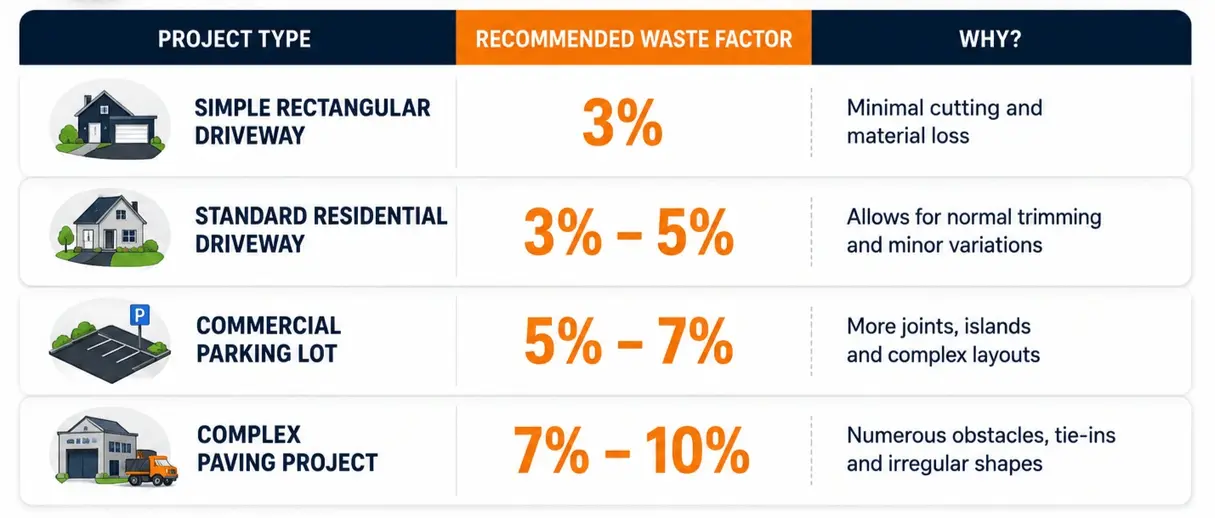
There isn’t a single waste factor that works for every paving project. The right percentage depends on the shape, complexity, and site conditions.
Use the table below as a practical starting point:
| Project Type | Recommended Waste Factor | Why? |
| Simple rectangular driveway | 3% | Minimal cutting and material loss |
| Standard residential driveway | 3–5% | Allows for normal trimming and minor variations |
| Curved or irregular driveway | 5–7% | More cutting and edge waste |
| Residential parking area | 5% | Multiple edges and larger paving area |
| Commercial parking lot | 5–8% | More joints, islands, and complex layouts |
| Roads and large paving projects | 5–8% | Accounts for production and equipment losses |
| Complex commercial projects | 8–10% | Numerous obstacles, tie-ins, and irregular shapes |
Contractor Tip: If you’re unsure which percentage to use, 5% is the safest choice for most residential paving projects. Increase the waste factor only when the project includes curves, irregular shapes, or difficult site conditions.
How to Choose the Right Waste Factor
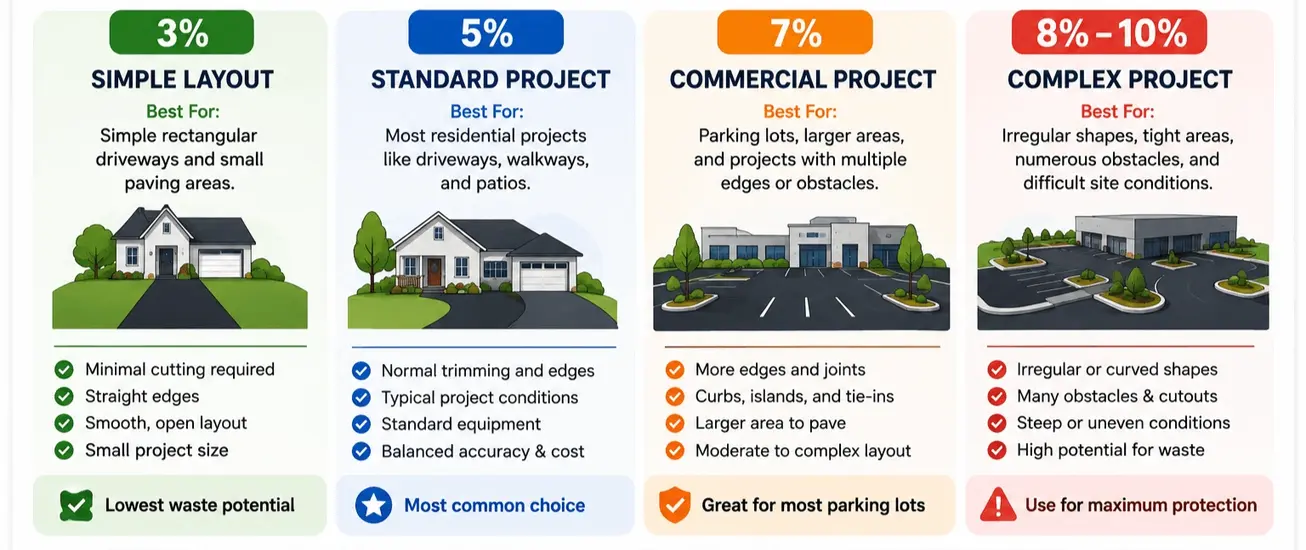
Choosing the right waste factor is simple if you evaluate the project before ordering asphalt.
Use 3% if:
- The area is rectangular
- Very little cutting is required
- The base is smooth and level
Use 5% if:
- It’s a standard residential driveway
- Minor curves or grading adjustments are expected
- You’re unsure which percentage to choose
Use 7%–10% if:
- The project has multiple curves
- There are parking lot islands or tie-ins
- The layout is irregular or complex
Quick Rule: For most homeowners, a 5% waste factor provides the best balance between cost and accuracy.
Asphalt Waste Factor Decision Checklist
Before ordering asphalt, ask yourself these questions:
| Question | If Yes |
| Is the project rectangular? | Use around 3% |
| Does it have curves? | Increase to 5%–7% |
| Are there parking lot islands or tie-ins? | Consider 7%–10% |
| Is the base uneven? | Add a small safety margin |
| Not sure? | Use 5% for most residential jobs |
Asphalt Waste Factor Formula
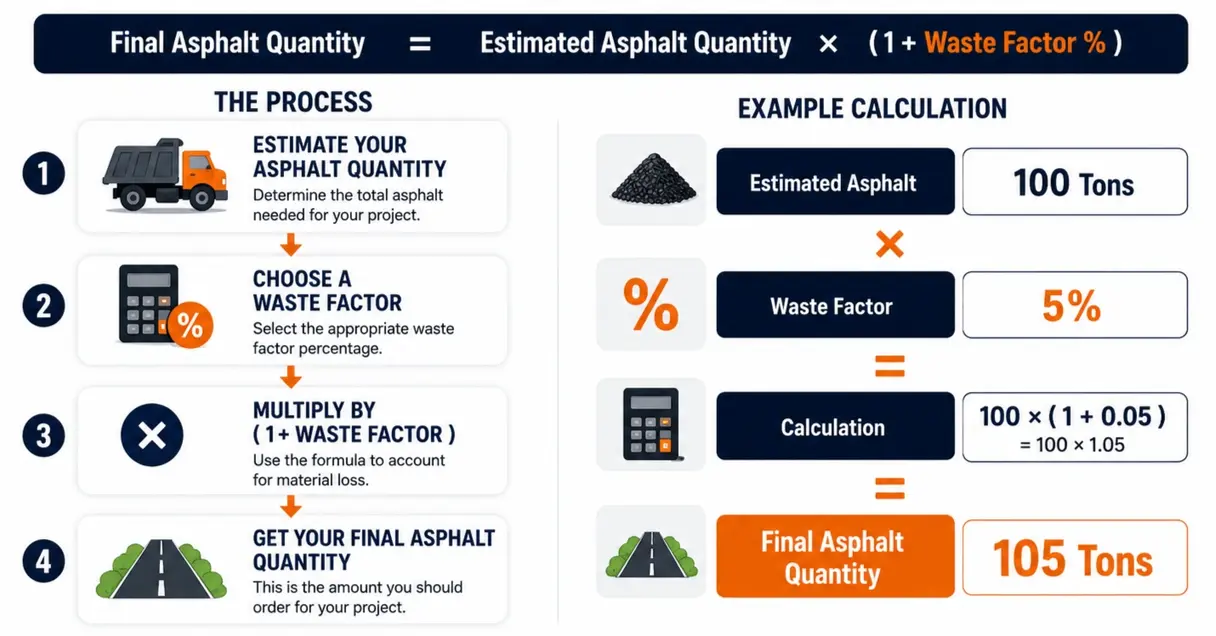
Use this simple formula to calculate how much asphalt to order:
Final Asphalt Quantity = Estimated Asphalt × (1 + Waste Factor)
Example:
- Estimated asphalt = 10 tons
- Waste factor = 5% (0.05)
Calculation:
10 × 1.05 = 10.5 tons
Order 10.5 tons of asphalt.
Formula Breakdown
| Item | Example |
| Estimated Asphalt | 10 tons |
| Waste Factor | 5% (0.05) |
| Multiplier | 1.05 |
| Final Order | 10.5 tons |
Tip: Convert the waste percentage into a decimal before using the formula. For example, 5% = 0.05.
Common Formula Mistakes
One of the most common estimating mistakes is multiplying the asphalt quantity by the waste percentage instead of adding it to the original estimate.
✅ Correct
10 × 1.05 = 10.5 tons
❌ Incorrect
10 × 0.05 = 0.5 ton
Always multiply by 1 + the waste factor, not the waste factor alone.
How to Calculate Asphalt Waste Factor
Once you’ve estimated the amount of asphalt your project needs, calculating the final order takes just three steps.
Step 1: Calculate Your Base Quantity
Measure the project’s length, width, and asphalt thickness, then calculate the required asphalt in tons or cubic yards.
Instead of calculating everything manually, use our Asphalt Calculator to estimate the required asphalt based on your project dimensions.
Step 2: Choose the Right Waste Factor
Select a percentage based on the project’s complexity.
- Simple driveway → 3%
- Standard residential project → 5%
- Commercial or complex layout → 7%–10%
Step 3: Apply the Formula
Multiply your estimated asphalt quantity by 1 + the waste factor to determine the final amount to order.
Example 1 – Residential Driveway
A driveway requires 10 tons of asphalt.
Recommended waste factor:
5%
Calculation:
10 × 1.05 = 10.5 tons
You should order approximately 10.5 tons.
Example 2 – Commercial Parking Lot
A parking lot requires 150 tons of asphalt.
Recommended waste factor:
8%
Calculation:
150 × 1.08 = 162 tons
Ordering 162 tons helps reduce the risk of project delays caused by material shortages.
Waste Factor vs. Compaction Allowance
Although these terms are often confused, they serve different purposes.
| Asphalt Waste Factor | Compaction Allowance |
| Covers material lost during paving | Accounts for thickness reduction after rolling |
| Used when estimating asphalt quantity | Used when determining installed pavement thickness |
| Typically 3%–10% | Depends on the asphalt mix and compaction requirements |
Can both be used together?
Yes. A compaction allowance ensures the pavement reaches the required finished thickness, while a waste factor helps prevent material shortages during construction.
Factors That Affect Asphalt Waste Factor
Several factors determine how much extra asphalt you should include in your estimate.
- Project Shape: Curves, parking lot islands, and irregular layouts create more trimming waste than simple rectangular areas.
- Surface Condition: Uneven or poorly prepared bases may require additional asphalt to achieve the desired thickness.
- Project Type: Residential driveways usually need a lower waste factor than large commercial paving projects.
- Crew and Equipment: Experienced crews and well-maintained equipment can help reduce material loss during paving.
- Weather Conditions: Extreme temperatures can affect paving operations, but they usually have less impact than project layout or site conditions.
Key Takeaway: For most projects, shape and surface condition have a much greater impact on waste than weather.
When Should You Increase the Waste Factor?
Increase your waste factor if:
- The project has multiple curves.
- The base is uneven.
- The layout includes tie-ins or islands.
- Precise measurements are difficult.
Keep it lower when:
- The area is rectangular.
- The base is smooth.
- Very little cutting is required.
Common Asphalt Waste Factor Mistakes
Avoid these common estimating mistakes:
- Ordering the exact calculated quantity without a waste factor.
- Using the same percentage for every project.
- Ignoring curves and irregular layouts, which usually create more waste.
- Confusing a waste factor with compaction allowance.
- Skipping a final measurement check before ordering.
Expert Tip: Accurate measurements are more important than using a larger waste factor. A well-measured project with a realistic waste factor is usually more accurate than adding extra material “just to be safe.”
Can Asphalt Waste Be Recycled?
Yes. In most cases, asphalt waste can be recycled and reused.
In fact, asphalt is one of the most recycled construction materials in the United States.
Old asphalt removed during milling or reconstruction is commonly processed into Reclaimed Asphalt Pavement (RAP). The recycled material is then mixed with new asphalt to produce fresh pavement for roads, driveways, and parking lots.
Recycling asphalt helps:
- Reduce landfill waste
- Lower demand for new raw materials
- Decrease construction costs
- Conserve natural resources
- Support more sustainable paving practices
For these reasons, many paving contractors routinely reuse reclaimed asphalt whenever project specifications allow.
Expert Tips for Accurate Asphalt Estimates
A waste factor should improve your estimate—not replace accurate measurements. Before ordering asphalt, double-check the project’s dimensions, base condition, and layout. If the project includes curves, tie-ins, or irregular edges, increase the waste factor accordingly instead of guessing.
For most residential driveways, 5% is a practical starting point. Larger commercial projects should be evaluated individually based on their complexity and site conditions.
Bottom Line: Accurate measurements combined with the right waste factor almost always produce better estimates than simply ordering extra asphalt.
Asphalt Waste Factor Cheat Sheet
| Project Type | Recommended Waste Factor |
| Simple rectangular driveway | 3% |
| Standard residential driveway | 5% |
| Commercial parking lot | 5%–7% |
| Complex paving project | 7%–10% |
Quick Tip: If you’re unsure which percentage to use, 5% is the safest choice for most residential paving projects.
FAQs for Asphalt Waste Factor
What is a good asphalt waste factor?
Most residential paving projects use 3%–5%, while complex commercial projects typically require 5%–10%.
Is a 5% waste factor enough?
Yes. For most driveways and standard residential paving jobs, 5% provides a good balance between cost and accuracy.
Can I use the same waste factor for every project?
No. The correct waste factor depends on the project’s shape, site conditions, and overall complexity.
Does asphalt thickness affect the waste factor?
Not directly. Thickness changes the total asphalt required, while the waste factor covers normal material loss during construction.
What happens if I don’t include a waste factor?
You may run short of asphalt, resulting in additional delivery costs, project delays, and higher labor expenses.
Which projects require the highest waste factor?
Projects with curves, parking lot islands, irregular layouts, and difficult site conditions generally require the highest waste factor.
Conclusion
Using the right asphalt waste factor helps you order enough material without overspending. While 3%–5% works well for most residential projects, larger or more complex jobs may require a higher percentage.
By combining accurate measurements with the appropriate waste factor, you can reduce waste, avoid costly delays, and create more reliable asphalt estimates.