Quick Answer
The 20×40 asphalt driveway cost typically ranges from $3,200 to $6,400, with most U.S. homeowners spending around $4,800 to $5,600 for a standard installation. Your final price depends on factors such as asphalt thickness, base preparation, drainage, labor rates, and local material costs.
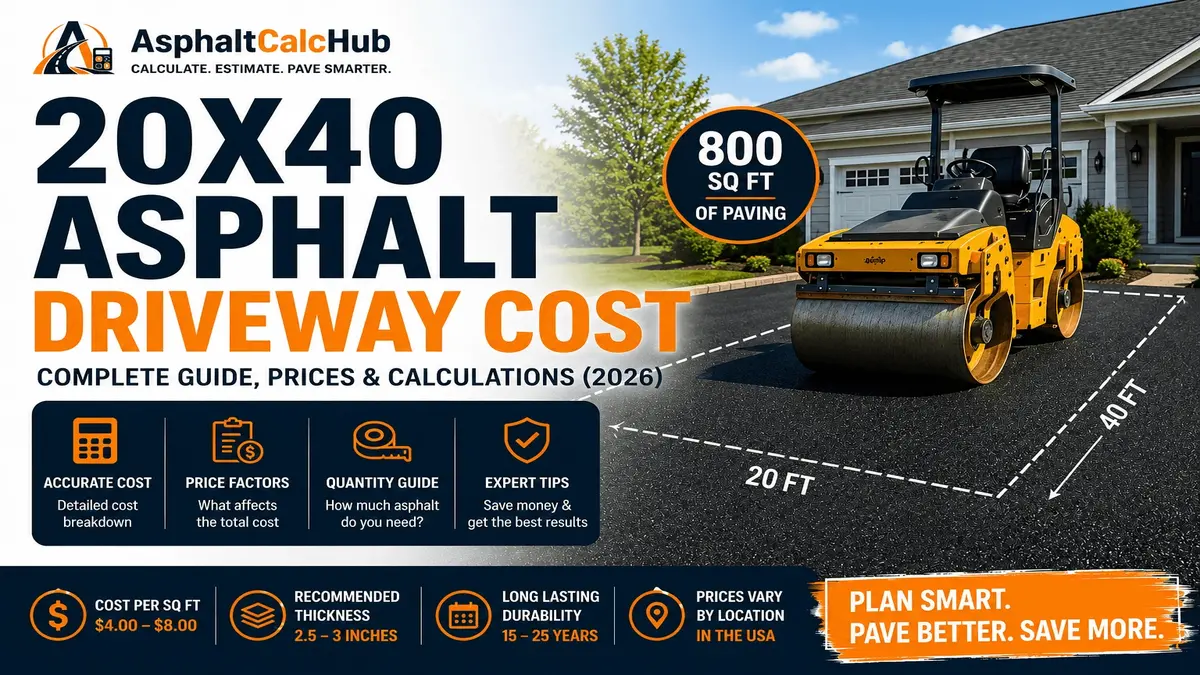
If you’re planning to install or replace a driveway, understanding the 20×40 asphalt driveway cost can help you budget with confidence. A 20×40 driveway covers 800 square feet, making it a common size for many U.S. homes. While national averages provide a good starting point, the actual cost can vary based on your location, site conditions, and the quality of installation.
In this guide, you’ll learn average pricing, cost per square foot, asphalt tonnage, major cost factors, and practical ways to save money without sacrificing quality.
In This Guide You’ll Learn
How Much Does a 20×40 Asphalt Driveway Cost?
A standard 20×40 asphalt driveway (800 sq ft) generally costs between $3,200 and $6,400 in the United States. Most homeowners pay $4,800 to $5,600 for a professionally installed driveway with proper grading, base preparation, and hot mix asphalt.
The exact price depends on more than just square footage. Contractors also consider the condition of the existing base, excavation needs, drainage, asphalt thickness, local labor rates, and equipment access before preparing an estimate.
20×40 Asphalt Driveway Cost at a Glance
| Item | Typical Estimate |
| Driveway Size | 20 × 40 ft |
| Total Area | 800 sq ft |
| Average Total Cost | $4,800–$5,600 |
| Typical Price Range | $3,200–$6,400 |
| Average Cost Per Sq Ft | $4–$8 |
| Asphalt Thickness | 2–4 inches |
| Installation Time | 1–3 Days |
| Expected Lifespan | 15–25 Years |
Quick Tip: Compare what each quote includes—not just the final price. A slightly higher estimate may include better base preparation and a longer-lasting pavement.
Estimated Cost by Project Type
| Project Type | Typical Cost | Best For |
| Budget Installation | $3,200–$4,000 | Flat sites with minimal preparation |
| Standard Installation | $4,000–$5,600 | Most residential driveways |
| Premium Installation | $5,600–$6,400+ | Thicker asphalt, stronger base, improved drainage |
A premium installation often costs more upfront because it includes a stronger aggregate base, better compaction, and improved drainage. These upgrades help reduce cracking, rutting, and premature pavement failure over time.
What’s Usually Included?
A standard residential asphalt driveway installation typically includes:
- Site preparation
- Minor grading
- Aggregate base preparation (if needed)
- Hot Mix Asphalt (HMA) paving
- Machine compaction
- Basic edge finishing
- Job site cleanup
Some contractors charge separately for demolition, permit fees, or drainage improvements. Always ask for an itemized estimate before signing a contract.
Note: If one quote is much cheaper than the others, check whether excavation, disposal, or the gravel base has been excluded.
20×40 Asphalt Driveway Cost Per Square Foot
Most paving contractors price residential driveways by square footage, making it easy to estimate costs for an 800-square-foot project.
For a 20×40 asphalt driveway, the average installed price is $4 to $8 per square foot, including materials, labor, and standard installation. However, projects that require significant excavation, drainage work, or a thicker asphalt layer can exceed this range.
| Cost Per Sq Ft | Estimated Total Cost |
| $4 | $3,200 |
| $5 | $4,000 |
| $6 | $4,800 |
| $7 | $5,600 |
| $8 | $6,400 |
Why Does the Price Per Square Foot Change?
Several factors influence the installed cost per square foot, including:
- Asphalt thickness
- Aggregate base condition
- Subgrade stability
- Excavation requirements
- Grading and drainage
- Local labor rates
- Material availability
- Equipment accessibility
- Regional demand
For example, a flat driveway with a stable subgrade usually costs less than a sloped property that requires excavation, drainage improvements, and additional base material before paving.
Quick Tip: The cheapest price per square foot isn’t always the best value. Proper base preparation has a bigger impact on driveway lifespan than saving a few dollars during installation.
Average Cost by State
| State | Average Cost |
| Texas | $3,600–5,800 |
| Florida | $3,400–5,900 |
| California | $5,000–7,500 |
| New York | $5,200–7,800 |
| Illinois | $4,000–6,200 |
How Much Asphalt Is Needed for a 20×40 Driveway?
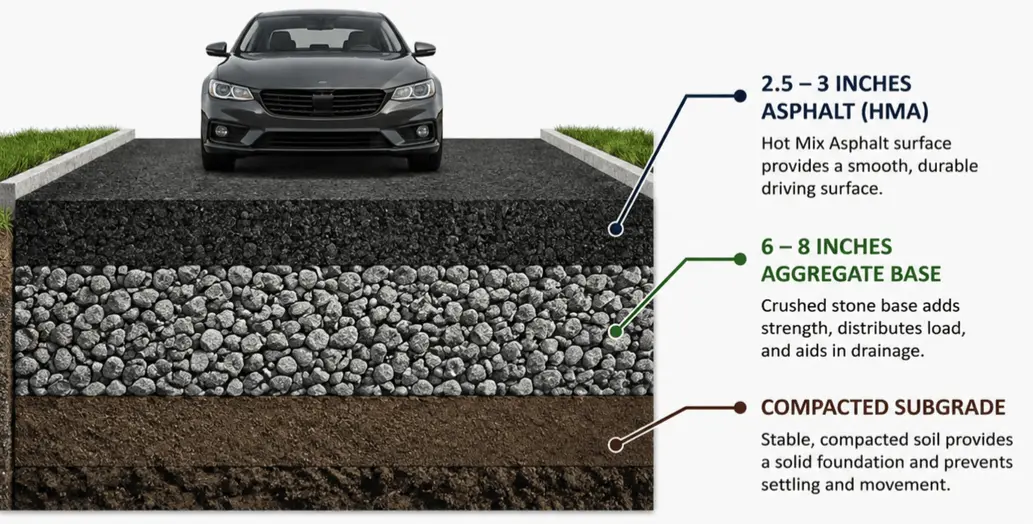
A 20×40 driveway covers 800 square feet, but the amount of asphalt required depends on the finished pavement thickness after compaction. Most residential driveways use 2.5 to 3 inches of compacted Hot Mix Asphalt (HMA), while heavier vehicles may require a thicker surface.
Estimated Asphalt Required
| Compacted Thickness | Approximate Asphalt Needed | Recommended For |
| 2 inches | 9–10 tons | Light vehicle traffic |
| 2.5 inches | 11–13 tons | Most residential homes |
| 3 inches | 14–15 tons | SUVs, pickups, multiple vehicles |
| 4 inches | 18–20 tons | RVs, trailers, heavy-duty use |
For most homeowners, 2.5 to 3 inches of compacted asphalt over a properly prepared aggregate base provides the best balance of durability and cost.
Quick Tip: A thicker asphalt layer won’t last longer if it’s installed on a weak or poorly compacted base.
How Much Does a 20-Ton Load of Asphalt Cost?
Many homeowners search for the price of a 20-ton load of asphalt, but this can be misleading.
In most parts of the U.S., 20 tons of Hot Mix Asphalt typically costs $2,000 to $3,600 for the material alone. This price doesn’t include labor, grading, transportation, paving equipment, or base preparation.
Most residential contractors also combine several nearby projects into one asphalt delivery, so your driveway usually isn’t paying for an entire truckload by itself.
Note: Material cost is only one part of the project. Installation quality has a much bigger impact on long-term value.
If you want an exact material estimate, use our Asphalt Calculator to calculate asphalt tonnage based on your driveway dimensions and thickness.
What Affects the Cost of a 20×40 Asphalt Driveway?
Two driveways with the same 800-square-foot size can have very different prices. That’s because contractors estimate costs based on site conditions, material requirements, labor, and installation complexity—not just square footage.
Below are the biggest factors that influence your final price.
1. Asphalt Thickness
The thicker the asphalt, the more material and labor the project requires.
- 2 inches: Light residential use
- 2.5 inches: Standard residential driveways
- 3 inches: Heavy daily traffic
- 4 inches: RVs and commercial-style use
Choosing the right thickness helps prevent premature cracking and extends pavement life.
2. Base Preparation
The aggregate base supports the asphalt above it. If the base is weak or uneven, the pavement can crack even when high-quality asphalt is used.
Contractors may need to:
- Remove unstable soil
- Install crushed stone
- Compact the base in layers
- Improve drainage
A properly compacted base improves load-bearing capacity, reduces movement, and helps the driveway last longer.
Quick Tip: Investing in a strong base usually provides a better return than paying for an extra inch of asphalt.
3. Site Preparation and Excavation
If the existing soil or driveway isn’t suitable, excavation may be necessary before paving begins.
Additional work may include:
- Removing old asphalt or concrete
- Excavating soft soil
- Importing new base material
- Regrading the site
The more preparation your property needs, the higher the total installation cost.
4.Drainage and Grading
Water is one of asphalt pavement’s biggest enemies.
Proper grading directs water away from the driveway, while effective drainage protects the subgrade and aggregate base from moisture damage.
- French drains
- Swales
- Catch basins
- Edge drains
- Culverts
Although these upgrades increase the initial cost, they often prevent expensive repairs later.
Note: Standing water is one of the leading causes of early asphalt failure.
5. Labor and Local Material Prices
Labor costs vary across the United States. Homeowners in large metropolitan areas often pay more because of higher wages and operating costs.
Material prices also change based on:
- Local asphalt supply
- Transportation distance
- Fuel prices
- Seasonal demand
As a result, identical driveways can receive different estimates in different states.
6. Accessibility
A driveway that’s easy for paving equipment to reach generally costs less to install.
Projects may become more expensive if contractors must work around:
- Narrow access points
- Steep slopes
- Landscaping
- Fences or retaining walls
Restricted access usually increases labor time and equipment costs.
7. Permits and Local Regulations
Some cities and counties require permits before a driveway is installed or replaced.
Permit requirements vary depending on:
- Property location
- Driveway expansion
- Curb modifications
- Drainage changes
Ask your contractor whether permit fees are included in the estimate.
8. Typical Cost Breakdown
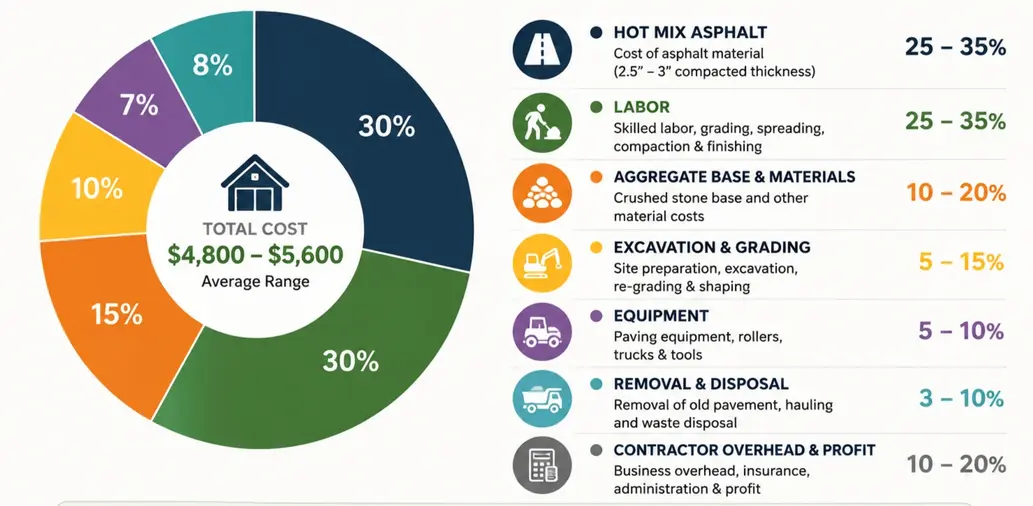
Understanding where your money goes makes it easier to compare contractor quotes.
| Cost Category | Typical Share |
| Hot Mix Asphalt | 25–35% |
| Labor | 25–35% |
| Aggregate Base & Materials | 10–20% |
| Excavation & Grading | 5–15% |
| Equipment | 5–10% |
| Removal & Disposal | 3–10% |
| Contractor Overhead & Profit | 10–20% |
These percentages vary depending on your property’s condition and the amount of preparation required before paving.
Quick Tip: Ask for an itemized quote. It helps you compare contractors fairly and identify hidden costs before work begins.
Read More Guide:
Asphalt vs. Concrete Driveway Cost
If you’re installing a new driveway, you’ll likely compare asphalt and concrete. Asphalt usually costs less upfront and is easier to repair, while concrete offers a longer lifespan with less routine maintenance.
The better choice depends on your budget, climate, expected traffic, and how long you plan to stay in your home.
Cost Comparison
| Feature | Asphalt | Concrete |
| Average Total Cost | $3,200–$6,400 | $4,800–$9,600 |
| Average Cost Per Sq Ft | $4–$8 | $6–$12 |
| Typical Lifespan | 15–25 Years | 30–40 Years |
| Installation Time | 1–3 Days | 3–7 Days |
| Drive-On Time | 2–7 Days | 7+ Days |
| Repair Cost | Lower | Higher |
| Cold Climate Performance | Excellent | Good |
Which Driveway Offers Better Value?
Choose asphalt if you:
- Want a lower upfront cost
- Need faster installation
- Live in a cold climate with freeze-thaw cycles
- Prefer lower repair costs
Choose concrete if you:
- Plan to stay in your home long-term
- Want decorative finishes
- Don’t mind paying more initially
- Prefer lower maintenance over time
For most homeowners, asphalt offers the best balance of affordability, durability, and repairability.
Quick Tip: Compare the total lifetime cost—not just the installation price. A cheaper driveway isn’t always the better investment.
Pros and Cons of an Asphalt Driveway
| Pros | Cons |
| Lower upfront cost | Requires periodic sealcoating |
| Fast installation | Shorter lifespan than concrete |
| Easy and affordable repairs | Can soften in extreme heat |
| Performs well in cold climates | Needs occasional crack repairs |
| Smooth driving surface | Color may fade over time |
Asphalt remains one of the most cost-effective driveway materials for homeowners. While it requires periodic maintenance such as sealcoating and crack repair, its lower installation cost and easy repairability make it an excellent long-term choice for many residential properties.
Overlay vs. Replacement: Which Costs Less?
If your existing driveway is worn, you may not need a complete replacement. A professional inspection can determine whether an asphalt overlay is enough or if the driveway needs a full rebuild.
Asphalt Overlay
An overlay adds a new layer of Hot Mix Asphalt (HMA) over an existing driveway that still has a stable base and subgrade.
Typical Cost: $2,500–$4,500
Best for:
- Minor surface cracks
- Small imperfections
- Structurally sound base
- Light surface wear
Pros
- Lower cost
- Faster installation
- Less demolition
- Improved appearance
Cons
- Doesn’t fix foundation problems
- Shorter lifespan than replacement
Full Driveway Replacement
A replacement removes the old pavement, repairs the foundation if needed, and installs new asphalt from the ground up.
Typical Cost: $4,800–$6,800+
Best for:
- Failed base
- Large cracks
- Potholes
- Drainage issues
- Uneven settlement
Pros
- Longer service life
- Stronger pavement
- Fixes underlying problems
- Better long-term value
Cons
- Higher upfront cost
- More labor and materials
| Feature | Overlay | Replacement |
| Typical Cost | $2,500–$4,500 | $4,800–$6,800+ |
| Removes Existing Driveway | No | Yes |
| Repairs Base Problems | No | Yes |
| Installation Time | Faster | Longer |
| Long-Term Durability | Moderate | Excellent |
Note: An overlay only works if the existing foundation is still structurally sound.
Hidden Costs Homeowners Often Miss
Many online estimates focus only on asphalt and labor. However, several additional expenses can increase your final project cost.
1. Driveway Removal
Replacing an old asphalt or concrete driveway usually requires demolition, hauling, and disposal.
2. Drainage Improvements
If water doesn’t drain properly, contractors may recommend French drains, catch basins, or additional grading.
3. Extra Excavation
Soft soil or poor subgrade conditions may require deeper excavation and additional aggregate base before paving.
4. Permit Fees
Some cities require permits for driveway replacement, expansion, or curb modifications.
5. Transportation Charges
Projects located far from an asphalt plant may have higher fuel and delivery costs.
6. Minimum Load Fees
Small residential jobs sometimes include minimum-load charges from the asphalt supplier.
Quick Tip: Ask whether your estimate includes demolition, permits, disposal, and cleanup to avoid unexpected charges
How to Save Money Without Sacrificing Quality
Saving money doesn’t mean hiring the cheapest contractor. The goal is to get the best long-term value for your investment.
Compare Multiple Quotes
Request at least three detailed estimates from reputable paving contractors.
Compare:
- Asphalt thickness
- Base preparation
- Drainage work
- Warranty
- Cleanup
- Final price
Keep a Good Existing Base
If your aggregate base is stable, your contractor may be able to reuse it instead of rebuilding the entire foundation.
Choose the Right Thickness
More asphalt isn’t always better.
For most homes, 2.5–3 inches of compacted asphalt provides excellent durability when installed over a properly prepared base.
Schedule During the Off-Season
In some regions, contractors may offer better pricing during slower months when demand is lower.
Maintain Your Driveway
Simple maintenance can extend pavement life and reduce repair costs.
- Repair cracks early
- Keep the surface clean
- Avoid heavy loads during curing
- Sealcoat when recommended
Quick Tip: Spending a little on maintenance today can help you avoid expensive repairs later.
Common Mistakes to Avoid
Avoid these common mistakes when choosing a contractor:
- Accepting the lowest bid without comparing details
- Ignoring drainage issues
- Choosing asphalt that’s too thin
- Skipping proper base preparation
- Not asking about the warranty
- Hiring an uninsured contractor
A detailed written estimate is usually a better indicator of quality than the lowest price alone.
Before You Hire a Contractor
Use this checklist before signing any contract:
- □ Asphalt thickness is clearly specified
- □ Aggregate base depth is included
- □ Drainage work is explained
- □ Demolition and disposal are listed
- □ Cleanup is included
- □ Warranty is provided in writing
- □ Permit fees are clarified
- □ Project timeline is included
- □ Payment terms are clear
- □ Contractor is licensed and insured (where required)
Quick Tip: An itemized estimate makes it much easier to compare contractors and avoid hidden costs.
FAQ for 20×40 Asphalt Driveway Cost
How much does a 20×40 asphalt driveway cost?
A 20×40 asphalt driveway typically costs $3,200 to $6,400, while most homeowners pay around $4,800 to $5,600. Your final price depends on asphalt thickness, site preparation, labor rates, and local material costs.
How much asphalt is needed for an 800-square-foot driveway?
An 800 sq ft driveway usually requires:
2 inches: 9–10 tons
2.5 inches: 11–13 tons
3 inches: 14–15 tons
4 inches: 18–20 tons
The exact amount depends on the finished pavement thickness and compaction.
How much does a 20-ton load of asphalt cost?
A 20-ton load of Hot Mix Asphalt (HMA) generally costs $2,000 to $3,600 for materials alone. Labor, equipment, grading, transportation, and base preparation are additional costs.
Is asphalt cheaper than concrete?
Yes. Asphalt generally costs less to install than concrete and is also less expensive to repair. Concrete lasts longer, but its upfront installation cost is usually higher.
How long does an asphalt driveway last?
A properly installed asphalt driveway typically lasts 15 to 25 years with routine maintenance, good drainage, timely crack repairs, and periodic sealcoating.
Can I install asphalt over an existing driveway?
Yes, but only if the existing pavement has a stable base and subgrade. If there are major cracks, drainage issues, or foundation failure, a full replacement is usually the better option.
Does driveway thickness affect the price?
Yes. Thicker asphalt requires more material and labor, increasing the total installation cost. Most residential driveways perform well with 2.5 to 3 inches of compacted asphalt over a properly prepared aggregate base.
When is the best time to install an asphalt driveway?
Late spring through early fall is usually the best time because warm temperatures allow asphalt to be placed, compacted, and cured more effectively.
Does a new asphalt driveway increase home value?
A new asphalt driveway can improve curb appeal and make your property more attractive to buyers. While it may not dramatically increase market value, it often improves first impressions and reduces maintenance concerns.
Conclusion
The 20×40 asphalt driveway cost typically falls between $3,200 and $6,400, but the right price depends on more than just square footage. A well-prepared base, proper drainage, the correct asphalt thickness, and a reputable contractor all play a major role in your driveway’s long-term performance.
Before making a decision, compare several detailed quotes and focus on overall value rather than the lowest price. A quality installation can last 15 to 25 years, making it a worthwhile investment for your home.
Sources
This guide is based on industry best practices and publicly available information from:
- National Asphalt Pavement Association
- Asphalt Institute
- Federal Highway Administration