Quick answer: Asphalt milling is used to remove a controlled layer of existing asphalt for resurfacing, pavement repairs, elevation correction, and rehabilitation. The removed material can also be recycled or reused as asphalt millings or reclaimed asphalt pavement (RAP).
Asphalt milling is more than simply grinding up an old road or driveway. If you’re wondering what is asphalt milling used for, the process allows contractors to remove only the pavement that needs attention while preserving suitable material underneath. It is commonly used before an asphalt overlay, to correct surface and elevation problems, and to recover pavement material for recycling.
For property owners, the term can also refer to the reclaimed material used in applications such as driveways and private roads.
In This Guide, You’ll Learn
What Is Asphalt Milling Used For?
Asphalt milling is primarily used to remove a controlled layer of existing pavement so the surface can be repaired, resurfaced, or rehabilitated.
Common uses include:
- Preparing pavement for an asphalt overlay
- Removing worn or deteriorated asphalt
- Correcting pavement elevations
- Reducing ruts and surface irregularities
- Improving pavement profiles around drainage structures and entrances
- Removing selected pavement before deeper repairs
- Recovering asphalt for recycling
The important distinction is between a surface problem and a structural problem. Milling can remove damaged surface material, but it cannot repair a failed base or unstable subgrade by itself.
The amount of asphalt needed for a pavement project depends on the area’s dimensions and the planned pavement thickness. You can use our asphalt calculator to estimate the material quantity for your project.
How Does Asphalt Milling Work?
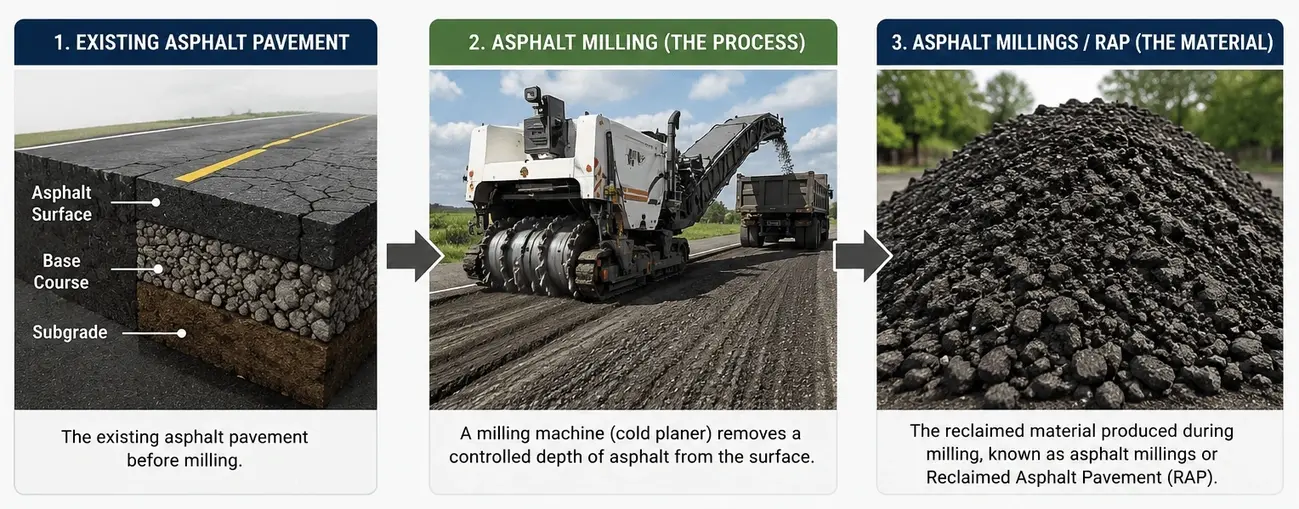
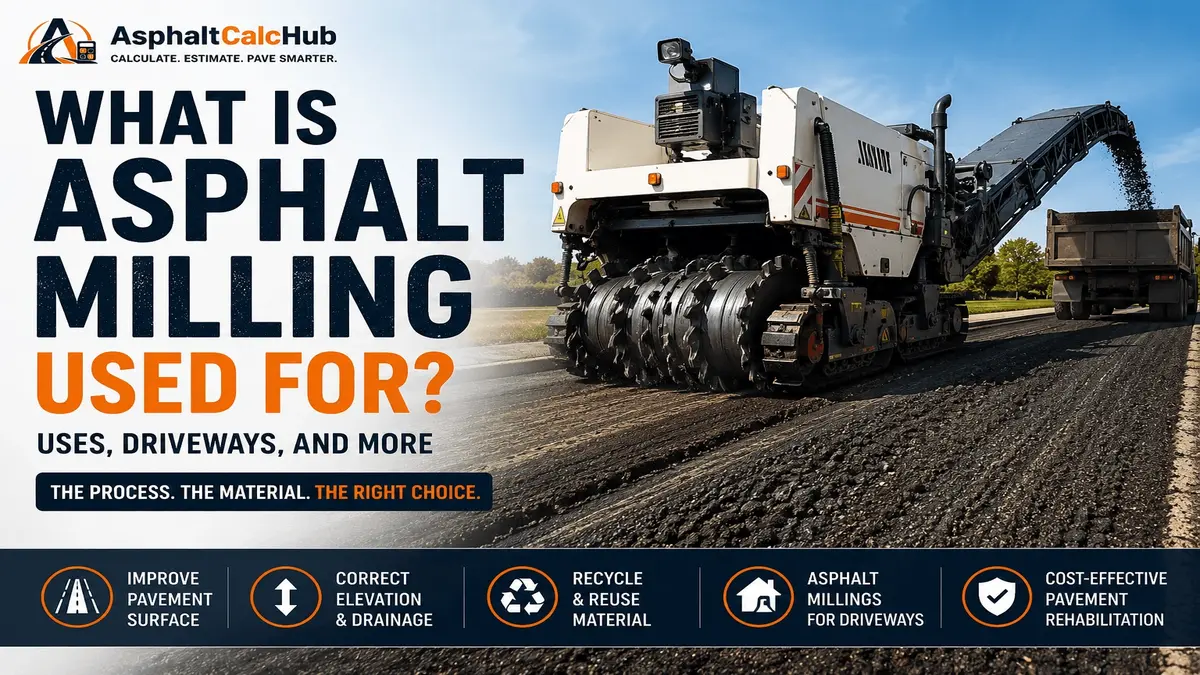
Asphalt milling uses a machine called a cold planer, or milling machine, to remove pavement with a rotating cutting drum. The operator can control the milling depth based on the condition of the pavement and the project’s requirements.
The removed asphalt is collected and transported for recycling, reuse, or further processing. The depth of milling depends on whether the project needs surface correction, overlay preparation, or deeper pavement removall.
Asphalt Milling vs. Asphalt Millings
| Term | Meaning |
| Asphalt milling | The process of mechanically removing existing asphalt |
| Asphalt millings | The reclaimed material produced during milling |
| RAP | Reclaimed asphalt pavement that can be processed and reused |
In simple terms, milling is the process; millings are the material.RAP refers to reclaimed asphalt pavement recovered from existing asphalt pavement and processed for reuse.
What Is Asphalt Milling Used For Before Resurfacing?
One of the most common uses of asphalt milling is preparing existing pavement for an asphalt overlay.
If a road or parking lot has accumulated several layers of asphalt, adding another layer can raise the finished surface too high around curbs, drainage structures, sidewalks, and entrances. Milling removes a controlled amount of the existing pavement first, creating space for the new asphalt while helping maintain the intended elevation.
When the underlying pavement is still structurally sound, this can be a more practical rehabilitation approach than removing the entire pavement section.
Removing Worn or Damaged Asphalt
Milling can remove worn or deteriorated asphalt from the pavement surface before a new treatment is applied.
It may be used to address problems such as:
- Surface rutting
- Raveling
- Uneven pavement
- Oxidized or brittle surface material
- Deteriorated areas that need to be removed before repair
The milling depth should match the condition of the pavement and the planned repair.
Pro tip: Before choosing a milling depth, identify which pavement layer is failing. A surface problem and a foundation problem require different repairs.
Correcting Pavement Elevation and Drainage
What is asphalt milling used for when a pavement surface has become too high? Milling can also correct pavement height, slopes, and surface irregularities before resurfacing.
This is useful when repeated overlays have raised the pavement near curbs, sidewalks, drainage inlets, manholes, garage floors, or driveway entrances. Removing a controlled amount of asphalt can create room for the new surface and help restore the intended profile.
Milling can also remove surface-level rutting and uneven areas when the underlying pavement structure is still suitable for rehabilitation.
When Is Asphalt Milling the Right Choice?
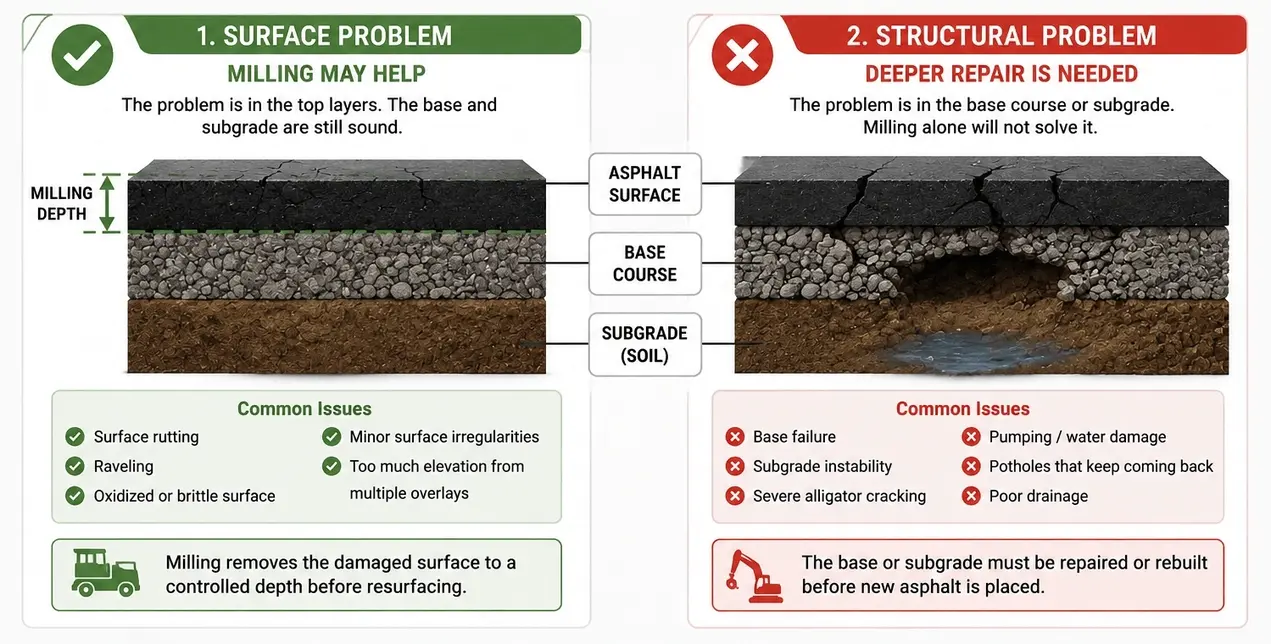
Asphalt milling is most useful when the main problem is in the existing pavement surface and the underlying structure is still suitable for rehabilitation.
Milling may be appropriate when:
- The surface is worn or deteriorated
- An asphalt overlay is planned
- Previous overlays have raised the pavement too high
- Ruts or surface irregularities need correction
- Selected areas need to be removed before repair
- The existing pavement still has adequate structural support
Deeper repair may be needed when:
- The base has failed
- The subgrade is unstable
- Severe structural cracking is widespread
- Water has damaged the pavement structure
- Surface repairs keep failing
Simple rule: If the problem is mainly at the surface, milling may help. If the foundation has failed, the repair needs to go deeper.
What Happens to Asphalt After It Is Milled?
Milled asphalt can be collected, transported, processed, and reused rather than discarded.
A major reuse option is reclaimed asphalt pavement (RAP), which can be incorporated into new asphalt mixtures when it meets the requirements for the intended application. Reclaimed material may also be used in certain pavement-related applications.
The material’s gradation, asphalt content, cleanliness, and processing can affect how it is reused.
For asphalt projects where material quantities are being estimated, the asphalt waste factor is another calculation worth considering.
What Are Asphalt Millings Used For?
Asphalt millings are the reclaimed material produced when existing asphalt is milled.
Depending on the material and project requirements, they may be used for:
- Residential and rural driveways
- Private roads
- Access roads
- Parking and storage areas
- Road shoulders
- Certain pavement-related base applications
- Recycling into new asphalt mixtures
The best use depends on the material’s properties and the demands of the site.
Are Asphalt Millings Good for a Driveway?
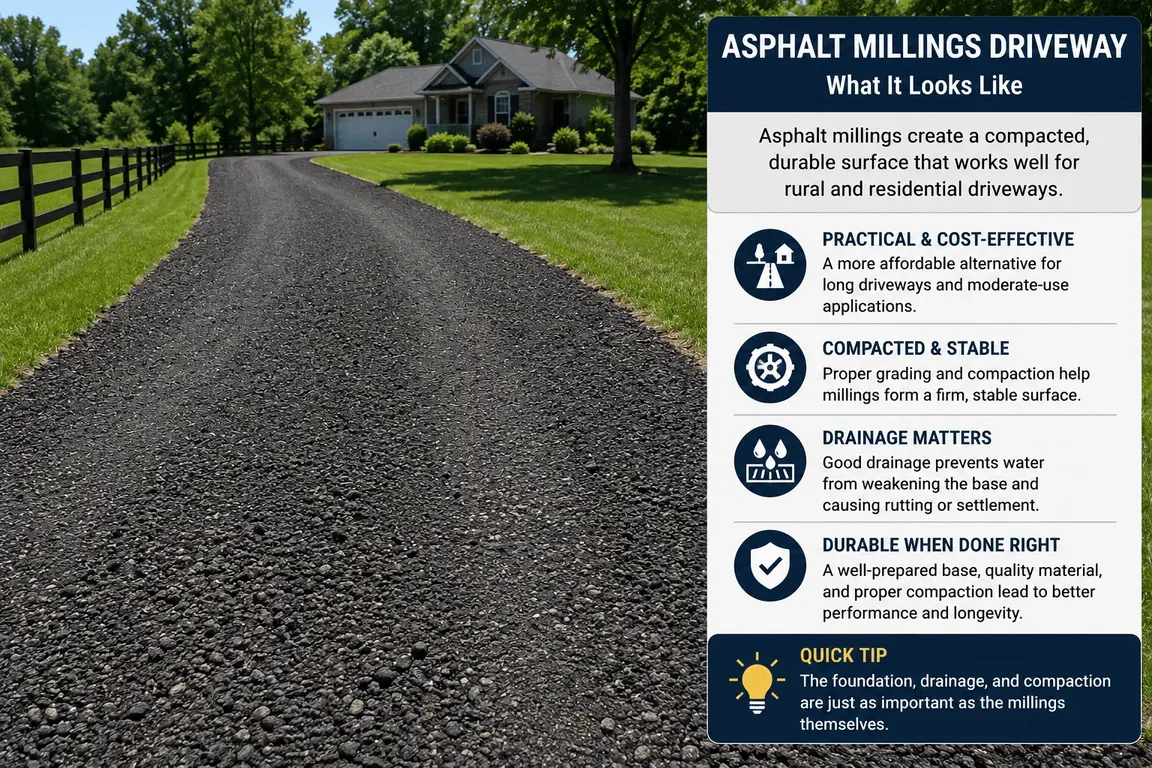
Yes, an asphalt millings driveway can be a practical option for rural and residential properties when the site is properly prepared.
Millings can work well for longer driveways, farm access, and other moderate-use applications where a smooth, uniform hot-mix asphalt finish is not essential.
If you’re comparing millings with a conventional asphalt driveway, you can also see how much a typical 20×20 driveway may cost.
What makes a millings driveway perform well?
The most important factors are:
- A stable base and subgrade
- Good drainage
- Proper grading
- Thorough compaction
- Suitable reclaimed material
- Traffic that matches the surface’s capabilities
If the underlying soil is weak or stays wet, the driveway can rut or settle regardless of the quality of the millings.
Quick tip: Don’t evaluate millings by material price alone. Ask how the base, drainage, grading, and compaction will be handled.
How Do Asphalt Millings Perform?
Properly placed and compacted asphalt millings can form a firm, stable surface. The reclaimed asphalt contains aggregate and residual asphalt binder, and compaction helps the material lock together.
However, a compacted millings surface should not be described as identical to new hot-mix asphalt. Hot-mix asphalt is an engineered mixture produced and placed under controlled conditions, while reclaimed millings have different material characteristics.
Why Compaction Matters
Proper compaction helps loose millings lock together and form a more stable surface. But compaction cannot correct a weak or waterlogged foundation.
There is no fixed lifespan for every millings driveway or road. Performance depends on the base and subgrade, drainage, compaction, traffic, material quality, climate, and maintenance.
Asphalt Millings vs. Gravel for a Driveway
Both can be practical driveway materials, but they offer different surface characteristics.
| Factor | Asphalt Millings | Gravel |
| Appearance | Dark, pavement-like | Natural stone |
| Surface | Can become firm after compaction | Loose aggregate |
| Dust | Usually lower after compaction | More likely |
| Maintenance | May need periodic correction | Often needs grading |
Neither is automatically better. The choice depends on the site’s drainage, soil, traffic, appearance requirements, and maintenance needs.
Asphalt Millings vs. New Asphalt
Asphalt millings are reclaimed pavement material; new hot-mix asphalt is an engineered mixture produced with controlled aggregate and asphalt binder proportions.
New asphalt generally provides a smoother, more uniform surface and is suitable for a wider range of pavement applications. Millings can be a practical alternative when the project does not require that finish and the site is suitable for reclaimed material.
The required pavement thickness also depends on the driveway or pavement’s intended use and site conditions.
In other words, millings are not simply “cheap new asphalt.” They are a different pavement material with different performance characteristics.
If you’re estimating material quantities for new asphalt, you can also learn how much a yard of asphalt represents.
Common Mistakes With Asphalt Millings
- Ignoring the Foundation: Millings cannot compensate for a weak base or unstable soil.
- Poor Drainage: Standing water can weaken supporting layers and contribute to rutting and settlement.
- Skipping Compaction: Loose millings are more likely to move under traffic than properly compacted material.
- Choosing Only by Price: Low material cost does not guarantee a low-cost project if grading, drainage, base preparation, or compaction is inadequate.
Asphalt Milling vs. Resurfacing vs. Full-Depth Replacement
These methods solve different pavement problems:
| Method | What it does | Typical use |
| Milling | Removes existing asphalt to a controlled depth | Surface correction or preparation |
| Overlay | Places new asphalt over suitable existing pavement | Restores the surface |
| Full-depth replacement | Removes and rebuilds failed pavement layers | Structural problems |
These methods can also be combined. For example, a parking lot may be milled first and then resurfaced.
Milling is therefore often one step in a larger pavement rehabilitation project, rather than the complete repair by itself.
That is why what is asphalt milling used for cannot be answered simply as “removing old asphalt.” Milling is often one step in a larger pavement rehabilitation process.
FAQ for Asphalt Milling Used
What is asphalt milling used for?
Asphalt milling is used to remove existing asphalt to a controlled depth for resurfacing, repairs, elevation correction, and pavement rehabilitation. The removed material can also be recovered for recycling.
What are asphalt millings used for?
They can be used for driveways, private roads, access areas, shoulders, certain base applications, and recycled asphalt mixtures when suitable.
Is asphalt milling the same as asphalt millings?
No. Asphalt milling is the removal process, while asphalt millings are the reclaimed material produced during milling.
Are asphalt millings good for a driveway?
They can be a practical choice for rural and moderate-use driveways with a stable base and good drainage. They do not provide the same finish as conventional hot-mix asphalt.
Do asphalt millings get hard?
Yes. Proper grading and compaction can help millings form a firm, stable surface.
How long do asphalt millings last?
There is no fixed lifespan. Base condition, drainage, compaction, traffic, material quality, climate, and maintenance all affect performance.
Does asphalt milling fix potholes?
Not necessarily. Milling can remove damaged pavement, but potholes caused by base failure or drainage problems may require deeper repairs.
Can you pave over asphalt millings?
It can be possible when the surface, grading, compaction, drainage, and underlying structure are properly prepared for new pavement.
Conclusion
What is asphalt milling used for? It is primarily a controlled pavement-removal method used to prepare asphalt for overlays, remove deteriorated surface material, correct pavement elevations, and support pavement rehabilitation.
The removed material can also be recycled or reused as asphalt millings or reclaimed asphalt pavement. For driveway applications, the foundation, drainage, grading, and compaction are just as important as the reclaimed material itself.